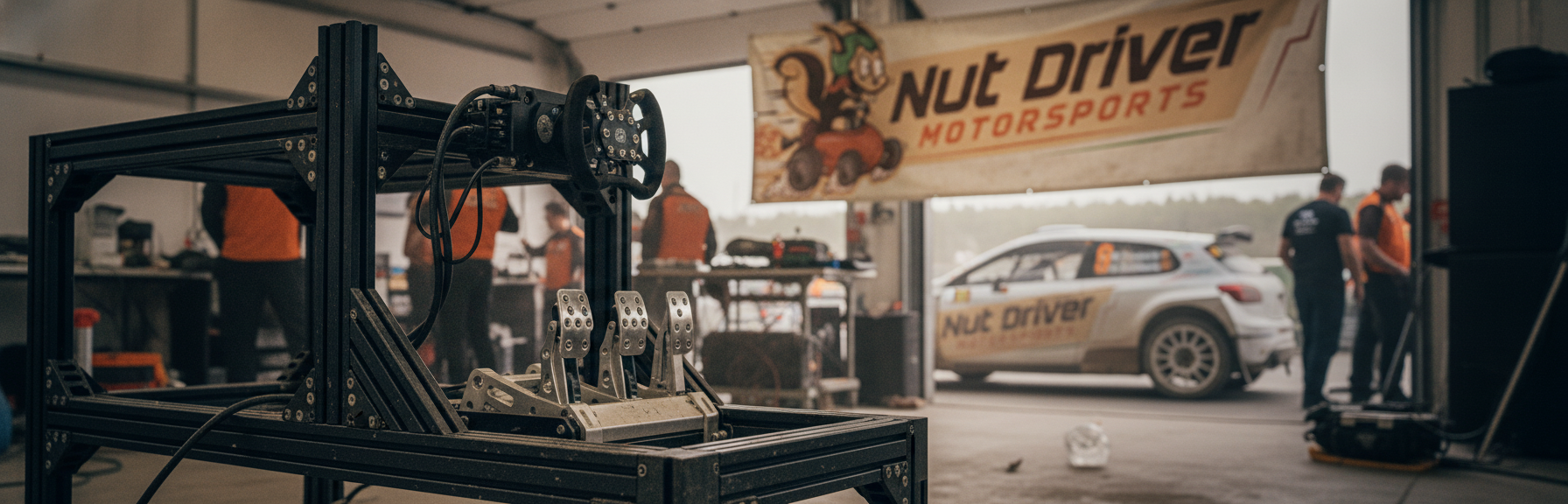
**[Nut Driver Approved]** Wrenches don't lie. People do. And let me tell you what the marketing department *won't* tell you about building a sim rig: the *first* decision—the chassis—is the only one that actually matters, because every single thing you bolt on after that is either fighting your choice or flowing with it. Today we're talking about the **Focus Sim Racing FSR One Twenty chassis**, and why starting with an extendable, accessory-ready aluminum extrusion platform fundamentally changes your buying roadmap compared to the poor suckers who thought a desk clamp and a prayer was a "foundation." **THE DESK RIG TRAP** Here's what happens when you start with a desk mount: you buy a wheelbase. You clamp it. It flexes. You add a reinforcement plate. Still flexes. You upgrade the pedals—now they're sliding on your carpet or crushing your floorboards because there's no integrated mounting surface. You want a monitor stand? Cool, you're either zip-tying an arm to your desk or buying a *separate* floor stand that doesn't share a single datum point with your wheel, so your screen bobs independently every time you brake. You want a shifter? Side-mounted buttonbox? You're drilling into furniture or praying double-sided tape holds under a dive-bomb into Eau Rouge. Every. Single. Addition. Is. A. Compromise. You're not building a rig. You're building a *Jenga tower of adapters*. **THE CHASSIS ADVANTAGE: SHARED DATUM, INFINITE EXPANSION** The FSR One Twenty is an 8020-style aluminum extrusion chassis—**1200mm of longitudinal rail** with T-slot compatibility on all four faces of every beam. That means *every accessory you will ever buy* shares the same mechanical reference plane. Your wheelbase? Bolted to the chassis. Your pedal plate? Bolted to the chassis. Your monitor stand? *Also bolted to the chassis.* They all move together. They all flex together—which is to say, they don't flex, because aluminum extrusion under proper preload is effectively rigid for sim racing loads. Here's the workflow difference: **Desk rig:** Wheel on desk → pedals on floor (independent) → monitor on desk arm (independent) → shifter clamped to desk edge (independent) → four separate failure points, zero shared reference. **Chassis rig (FSR One Twenty):** Wheel on front beam → pedals on integrated pedal plate → monitor stand bolted to rear uprights → shifter side-mounted to the *same extrusion the wheel is on* → one rigid assembly, one reference plane, infinite T-slot real estate for future expansion. **MOUNTING POINTS & DIMENSIONS: THE ACTUAL MATH** The One Twenty's front mounts accommodate **every major direct-drive wheelbase** on the market—Fanatec, Moza, Simucube, Simagic—using standard hole patterns. The pedal plate is pre-drilled for Heusinkveld, Simtag, and Thrustmaster load-cell sets, but because it's T-slot, you can add *custom* holes or slide-in brackets without permanently altering the structure. The seat rails? Adjustable along the full 1200mm length. That means you can tune your seating position *after* you've mounted everything else—not the otherway around, like a desk rig where your chair position is dictated by where your desk happens to be. The rear uprights are spaced to accept **single or triple monitor stands**—again, T-slot compatible, so you're not married to one brand's proprietary bracket. You want ultrawide? Fine. Triples? Fine. VR and a single center screen for streaming? *Also fine*, and you didn't have to buy three different stands to find out. **FLOOR PAN, CABLE MANAGEMENT, AND THE STUFF NOBODY TALKS ABOUT** Here's where the chassis pays dividends you didn't even budget for: the FSR One Twenty's open extrusion design lets you run a **custom floor pan** underneath—whether that's a rubber mat for anti-slip, a sheet of plywood for cable management and rigidity, or a full carbon-fiber tray if you're feeling fancy and have sponsorship money (which, spoiler, you don't). Desk rigs? Your cables dangle. They snag on your chair. They get yanked every time you roll backward. On a chassis, you zip-tie them to the underside of the extrusion, route them through the T-slots, and *they disappear*. It's not just cleaner—it's **safer**, because you're not going to rip your USB hub off mid-race when you shove your chair back during a Code Brown moment at Spa. **WHY THIS MATTERS FOR YOUR NEXT FIVE PURCHASES** Let's say you start with the One Twenty today. You mount your current wheel and pedals. Six months from now, you want to add a Buttkicker for tactile feedback. On a desk rig, you're either bolting it to your chair (which isolates it from the pedals and wheel) or shimming it under a desk leg and hoping your landlord doesn't complain. On the One Twenty? You bolt the transducer **directly to the seat rail extrusion**, and now your entire rig resonates as one unit. Curb strikes feel like curb strikes. Gearshifts punch through your spine. You're not adding an accessory—you're *integrating* it. Same logic for: - **Keyboard trays** (T-slot arm, swings out of the way when not streaming) - **Handbrake mounts** (side-bolt to the same rail as your shifter) - **Button boxes** (anywhere there's an open T-slot—which is *everywhere*) - **Wind sim fans, bass shakers, cup holders**—I've seen guys mount *all of it* without a single zip-tie to a desk leg. The chassis isn't just a frame. It's a **common mounting standard** for everything you're going to want in two years but don't know you want yet. **THE COST MATH NOBODY DOES UP FRONT** "But Twitch, a chassis costs more than a desk clamp!" Sure. And a foundation costs more than a tent. Let's do the *actual* math: **Desk rig total cost to "full build":** - Desk clamp wheel mount: $80 - Reinforcement plate (because it flexed): $60 - Separate floor pedal plate: $120 - Desk monitor arm: $150 - *Second* monitor arm because the first one couldn't hold triples: $150 - Shifter desk clamp: $40 - Cable management clips and zip ties: $20 - **Total: $620**, and it still flexes, and you can't add a transducer without starting over. **Chassis rig (FSR One Twenty):** - One chassis: ~$500-600 (depending on config and vendor) - *Everything else bolts directly to it with zero adapters.* - **Total: $500-600**, and you've got a platform that will outlive three wheelbase upgrades and never need a "reinforcement plate" because *aluminum doesn't care about your feelings or your lap times.* You're not paying more. You're paying *once*. **FINAL WORD: PLATFORM > PRODUCTS** If you're serious about sim racing—and I'm talking *actually* serious, not "I bought a G29 and I'm thinking about iRacing" serious—your first purchase shouldn't be the wheelbase with the prettiest RGB. It should be the **platform** that lets you mount, adjust, and expand everything else without re-buying half your rig every time you level up. The FSR One Twenty is that platform. Extendable, T-slot compatible, pre-drilled for the stuff you'll buy, and ready for the stuff you haven't thought of yet. It's the difference between building a rig and building a *system*. Wrenches don't lie. Your mounting points will. **–Twitch**


