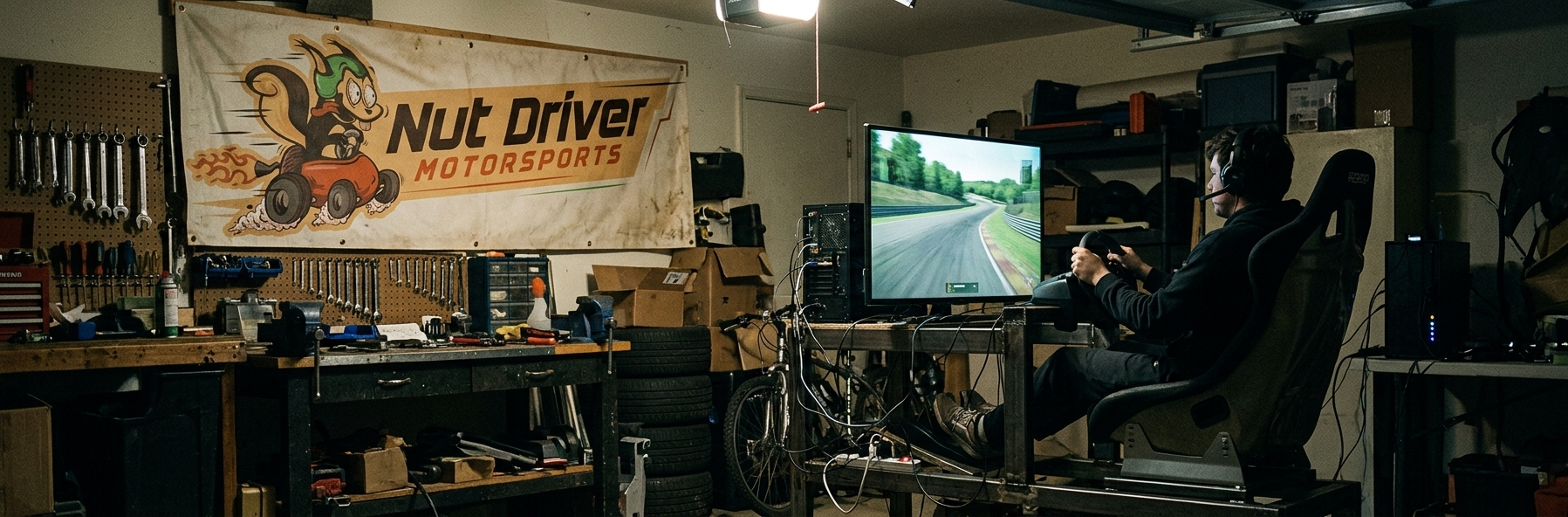
**[PADDOCK LEDGER — Sim Desk]** Gran Turismo just announced the "Eifel Cup 2026," a competition that combines what the platform does best—gorgeous screenshots of Porsches—with what the hardware industry does best: dangling mid-tier wheels and pedals in front of people who already own mid-tier wheels and pedals. The setup is straightforward. Run qualifying laps in a specially livered Porsche 911 GT3 RS around the Nürburgring Nordschleife—specifically the game's "Eifel" region interpretation—and the top finishers walk away with Fanatec hardware. The prize pool includes a CSL DD wheel base, McLaren GT3 V2 wheel, and CSL Pedals. Solid kit. Not the stuff you mortgage a house for, but more than adequate for someone who's been nursing a Logitech G29 since the Obama administration. Gran Turismo has always occupied a curious space in the sim-racing ecosystem. It's the gateway drug: beautiful, accessible, console-native, and about as close to motorsport as millions of people will ever get. It's not iRacing's laser-scanned tire-compound masochism. It's not Assetto Corsa Competizione's unforgiving physics punishment chamber. It's a game that wants you to *enjoy* driving a Porsche, not question whether you've got the right brake bias for Turn 8. And that's fine. The Eifel Cup isn't pretending to crown the next Max Verstappen. It's a time trial. You load in, you hot-lap, you post a time. The format rewards consistency, car control, and memorization of one of the most demanding circuits ever paved. The Nordschleife doesn't care what platform you're running—if you're not intimately familiar with Flugplatz, Adenauer Forst, and the Karussell, you're going to find the armco. Repeatedly. The Fanatec prize structure is smart marketing. CSL-tier hardware sits in the sweet spot: good enough to make a real difference if you're upgrading from a toy, attainable enough that it doesn't feel like chasing a unicorn. The kind of gear that survives a 24-hour endurance stint without spontaneously combusting, but won't require you to take out a line of credit. What's interesting here is the *Porsche* angle. Gran Turismo has had a long, complicated relationship with the Stuttgart manufacturer—licensing disputes kept the brand out of the game for years—so when Porsche shows up in a featured competition with a bespoke livery, it's not incidental. It's a statement: we're back, we're committed, and we're using one of the most iconic GT3 platforms ever built as the centerpiece. The 911 GT3 RS is the right car for this. Mid-engine exotics are faster on paper, but the rear-engine layout of the 911 rewards precision and punishes impatience in ways that feel *fair*. You know exactly why you spun. You know exactly where you gave up three-tenths. It's a teaching tool wrapped in a time trial. The Nordschleife is the right track for this. Seventy-three turns, 12.9 miles, elevation changes that'll compress your suspension and your confidence in equal measure. You can't cheese it. You can't memorize one optimal line and call it done. The circuit *demands* you understand weight transfer, trail braking, and when to trust the car versus when to trust your survival instincts. So what does this say about the current state of sim racing? First: the platform wars are over, and accessibility won. iRacing still owns the competitive endurance scene. ACC still owns the GT3 purists. But Gran Turismo owns *volume*. Millions of people with PlayStations, a couch, and a wheel clamped to a TV tray. That's the base. That's where the next generation of sim racers comes from. Competitions like the Eifel Cup meet people where they are, not where the hardcore think they should be. Second: hardware companies have figured out that the real money isn't in the $3,000 direct-drive bases the streamers buy—it's in the $300–$600 ecosystem upgrades that regular people actually purchase. Fanatec's CSL line exists because not everyone needs a Podium DD1. They need something better than the plastic fantastic they've been white-knuckling for five years. Competitions like this put that hardware in front of exactly the right audience: people who care enough to run hot laps but aren't dropping four figures on a load cell brake pedal yet. Third: manufacturers are paying attention. Porsche didn't commission a custom livery for this competition out of charity. They know that sim racing—especially on accessible platforms like Gran Turismo—is brand-building in a demographic that can't afford a real 911 GT3 RS yet but will remember which manufacturer let them drive one in a game when they were nineteen. This isn't the kind of event that'll make headlines in the iRacing World Championship paddock. It's not going to move the needle for the Porsche Esports Supercup drivers grinding setups at Spa. But it doesn't need to. The Eifel Cup is doing something more important: it's giving a few thousand people a reason to care about lap times, to learn a racing line, to understand why trail braking matters. And if a handful of them walk away with a CSL DD and a wheelbase mount they built themselves in the garage? Even better. That's the kind of DIY grit that turns a casual time-trial runner into someone who shows up at Sebring in iRacing at 2 a.m. on a Wednesday, chasing a qualifying time they *know* they can beat if they just nail Turns 16 and 17. Skills over bills. Always. The Eifel Cup won't make you a professional. But it might make you faster. And in sim racing, that's the only prize that actually matters once the hardware's been unboxed and the screenshots are posted. Now if you'll excuse me, I've got a Nordschleife lap time to chase. The W-01 Shell wasn't built for the 'Ring, but I didn't hollow out a walnut chassis to let a bunch of PlayStation kids show me up on a time sheet.


